The way your pouch is printed is a bigger cost decision than the artwork on it. Three methods dominate flexible packaging, and they do not compete on quality so much as on volume: the same design can cost wildly different amounts per pouch depending on whether you run 2,000 units or 200,000. Choosing the wrong method for your order size is one of the most expensive mistakes a growing brand makes, because the penalty is baked into every unit. Here is how digital, rotogravure, and flexographic printing actually differ, and how to tell which one your run belongs on.
Three Methods, Three Cost Structures
The dividing line is tooling. Rotogravure engraves your design into metal cylinders, one cylinder per color, and those cylinders are a fixed cost you pay before a single pouch prints. Flexography uses flexible photopolymer plates, again one per color, which cost less to make than engraved cylinders but still represent real up-front tooling. Digital prints straight from the file with no plates or cylinders at all, so its setup cost is effectively zero and a design change costs nothing to prepare. That single difference, fixed tooling versus none, drives everything else: the minimum order, the per-unit price, and the point at which one method overtakes another. It also shapes reorders. Once gravure cylinders or flexo plates exist, a repeat run of the same design skips the tooling step and prints faster and cheaper, so a brand that expects to reorder the identical artwork many times benefits from plated methods in a way a one-time run never will.
Rotogravure: Built for Big Volumes
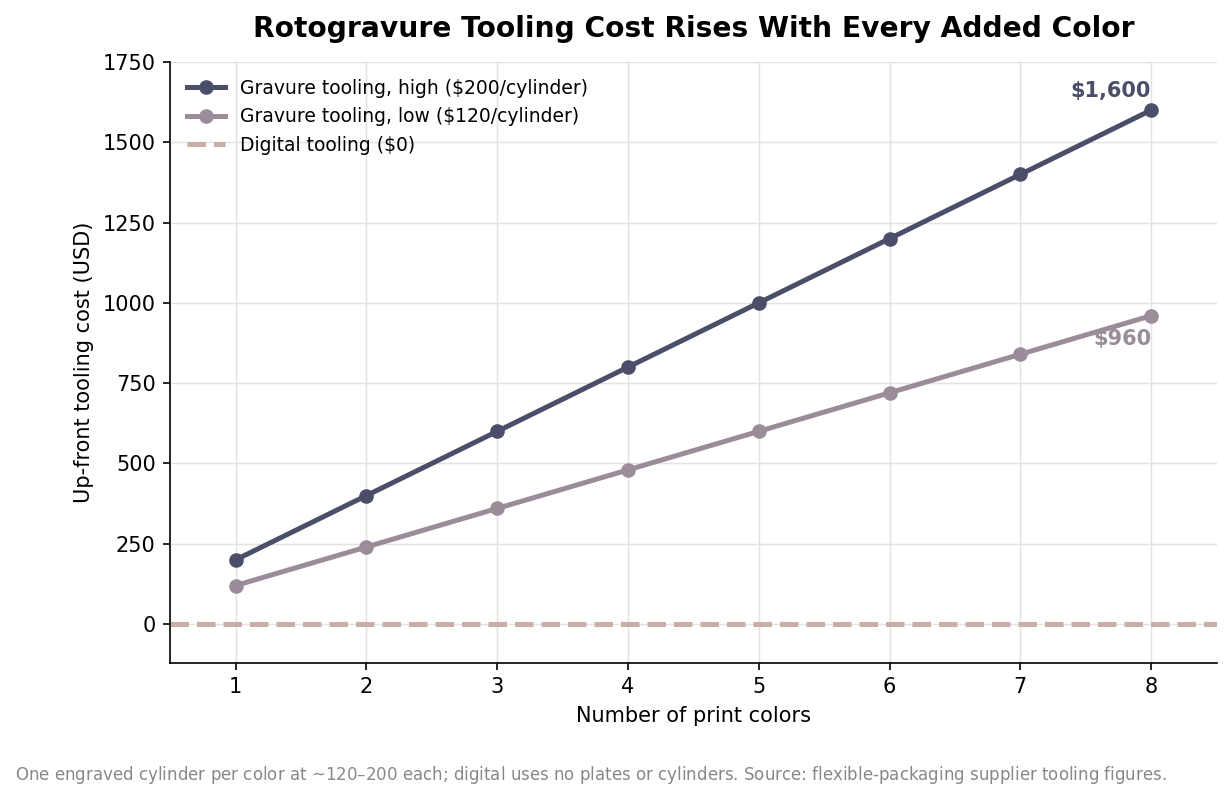
Rotogravure produces the best image quality of the three, with photo-like gradients, sharp lines, and color that stays consistent across hundreds of thousands of units, which is why premium and legacy brands favor it. The catch is the tooling. Engraved cylinders commonly run about $120 to $200 each, and because you need one per color, an eight-color design can mean roughly $1,000 to $1,600 in cylinders before production even starts. Minimum orders reflect that: for laminated pouches, gravure minimums often sit around 10,000 units as a guide, and new or revised artwork carries a lead time of about two to four weeks while the cylinders are engraved. Gravure only pays off when that fixed cost spreads across a large run, which is why it is typically reserved for high, repeating volumes.
Flexography: The Middle Ground
Flexographic printing occupies the space between digital and gravure. Its photopolymer plates are cheaper to produce than engraved cylinders but still add per-color tooling, so it carries a real minimum order without the eye-watering setup of gravure. Once the plates exist, the press runs fast, which makes flexo attractive for mid-volume orders where you want lower per-unit cost than digital but cannot justify gravure’s tooling. The tradeoff is quality: flexo handles solid colors and clean shapes well but struggles with the finest gradients and the most intricate detail, so a design leaning on photographic imagery may look softer than it would on gravure. For many brands it is the sensible bridge between a first digital run and a mature gravure program.
Digital: Short Runs and Many SKUs
Digital printing flips the cost structure. With no tooling, the minimum order can drop to a few hundred pouches or, at some digital-first shops, even to a handful for a limited edition, and turnaround for the print step is often measured in one to three days rather than weeks. That makes digital the natural home for new brands testing a product, for seasonal or limited runs, and for anyone carrying many SKUs or changing artwork often, since each variant prints with no added plate cost. Modern digital quality is strong enough that most shoppers will not notice a difference on shelf. The one place it loses is at scale: with no fixed cost to amortize, the per-unit price stays flat as volume climbs, so on a very large run digital ends up more expensive per pouch than a plated method.
Finding Your Crossover Point
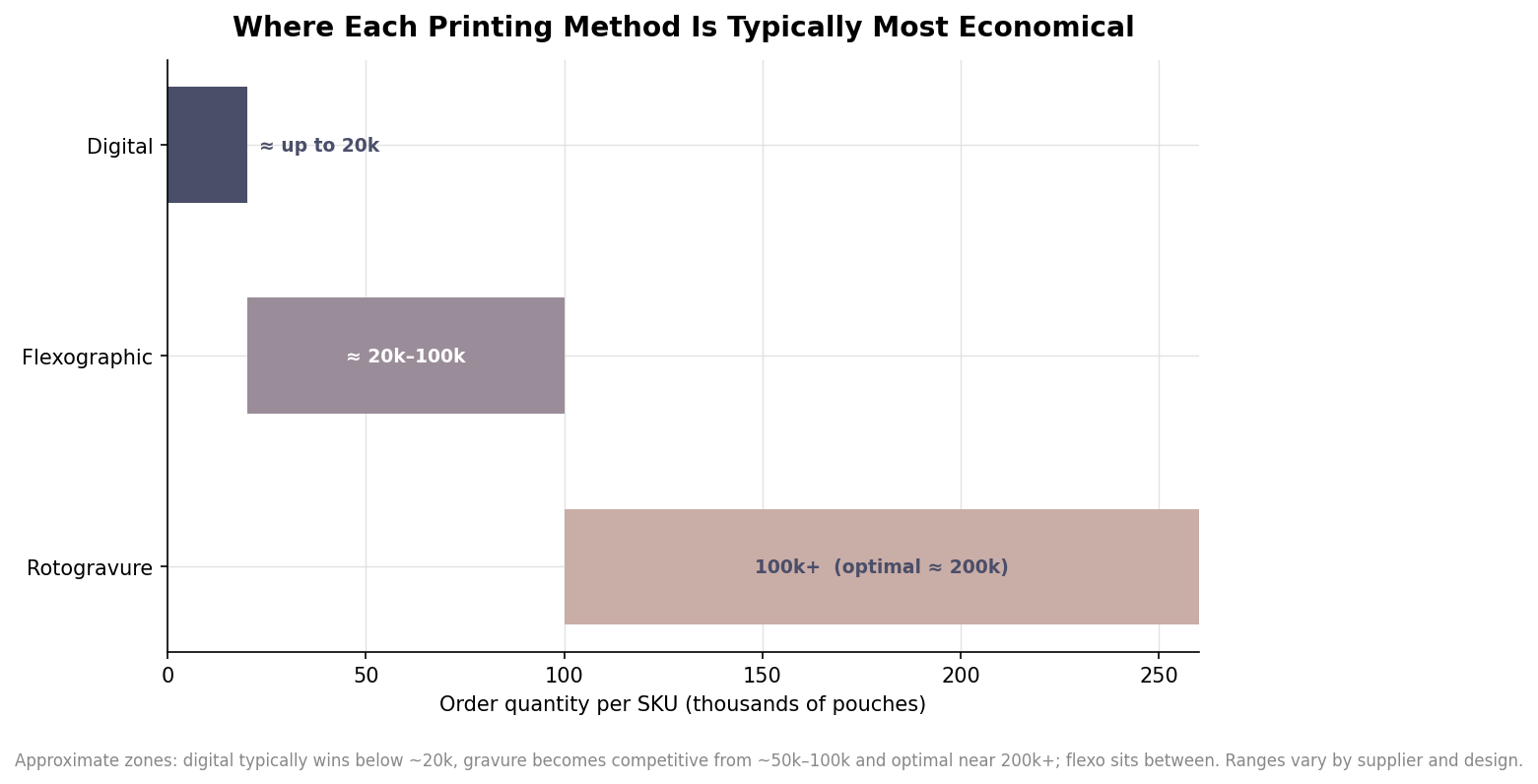
The decision comes down to where your order sits on the volume curve. As a rough guide, digital is typically the most cost-effective choice below about 20,000 units per SKU, gravure starts becoming competitive somewhere around 50,000 to 100,000 units, and it reaches its sweet spot at roughly 200,000 units or more of the same design per run, with flexography occupying the mid-volume ground between them. These thresholds are directional, not fixed, and they move with the number of colors, the pouch size, and each supplier’s press setup, so treat them as a starting frame rather than a rule. It helps to see how tooling amortizes. Take an eight-color gravure setup at roughly $1,300 in cylinders: spread over a 5,000-unit run that fixed cost alone adds about $0.26 to every pouch, but over 100,000 units it adds only about a cent and a third, and over 200,000 units it all but disappears. Those figures cover tooling only, not ink, film, or press time, but they show why the same cylinders that feel absurd on a small run barely register on a large one. The practical approach is to ask a supplier for a per-unit quote at your real order quantity under two methods at once, digital and whichever plated option fits, and let the crossover fall where your numbers actually land. Match the method to the run size and you stop paying for capability, or for tooling, that your volume does not need.