A stand-up pouch is not just a bag; it is food-contact packaging, and depending on what goes inside it can sit under food-safety law, environmental-marketing rules, and child-safety standards all at once. Most buyers focus on print quality and barrier and only discover the compliance layer when a retailer, a co-packer, or a state regulator asks a question they cannot answer. This is a plain-English map of the standards and certifications that actually apply to custom pouches, and, more usefully, what to ask your supplier to put in writing before you place an order.
Food-contact safety is the non-negotiable baseline
Any pouch that touches food or ingestible product has to be made from materials cleared for food contact. In the United States that means the film structure and its inks, adhesives, and coatings fall under the Food and Drug Administration’s food-contact rules in Title 21 of the Code of Federal Regulations, the same framework that governs food additives and food-contact substances. The practical concern is migration: nothing from the packaging should transfer into the product above permitted limits. If you export, the European Union’s Regulation 10/2011 on plastic food-contact materials is the parallel standard buyers ask about most.
What to request: a written statement of food-contact compliance for the specific structure you are buying, not a generic assurance, plus confirmation that the print inks and adhesives are food-grade and that any labels or valves are covered too. A supplier who packs food every day will have this documentation ready; hesitation is a signal worth heeding.
The PFAS question you now have to ask
Per- and polyfluoroalkyl substances, the grease- and water-resistant “forever chemicals,” have moved from a niche worry to a compliance requirement in a growing list of states. Laws restricting intentionally-added PFAS in food packaging are now in effect in a dozen states, phasing in from New York in 2022 through California, Washington, Vermont, and Connecticut, then Colorado, Maryland, Minnesota, and Hawaii, and on to Oregon, Rhode Island, and Maine. At the federal level, the FDA confirmed in 2024 that manufacturers had completed a voluntary phase-out of PFAS grease-proofing agents in paper and paperboard food packaging.
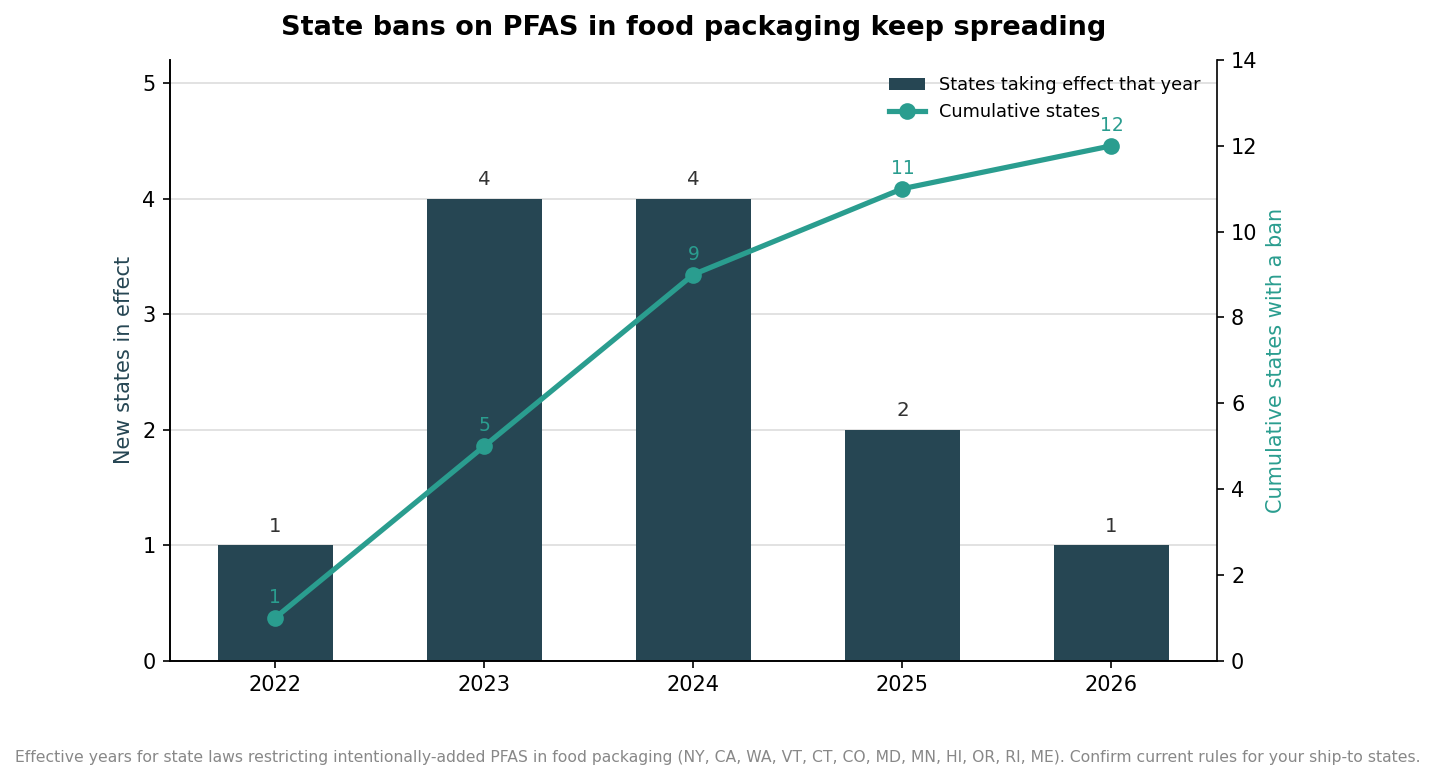
Most plastic laminate pouches were never grease-proofed with PFAS the way some molded-fiber and paper packaging was, but the safe move is not to assume. Because the state laws target intentionally-added PFAS across food packaging broadly, and because your product may ship into several of these states, ask your supplier to confirm in writing that the pouch is made without intentionally-added PFAS. That single line protects you as more states join the list and as retailers push the requirement down their supply chains.
Compostable and recyclable claims are regulated, not just marketing
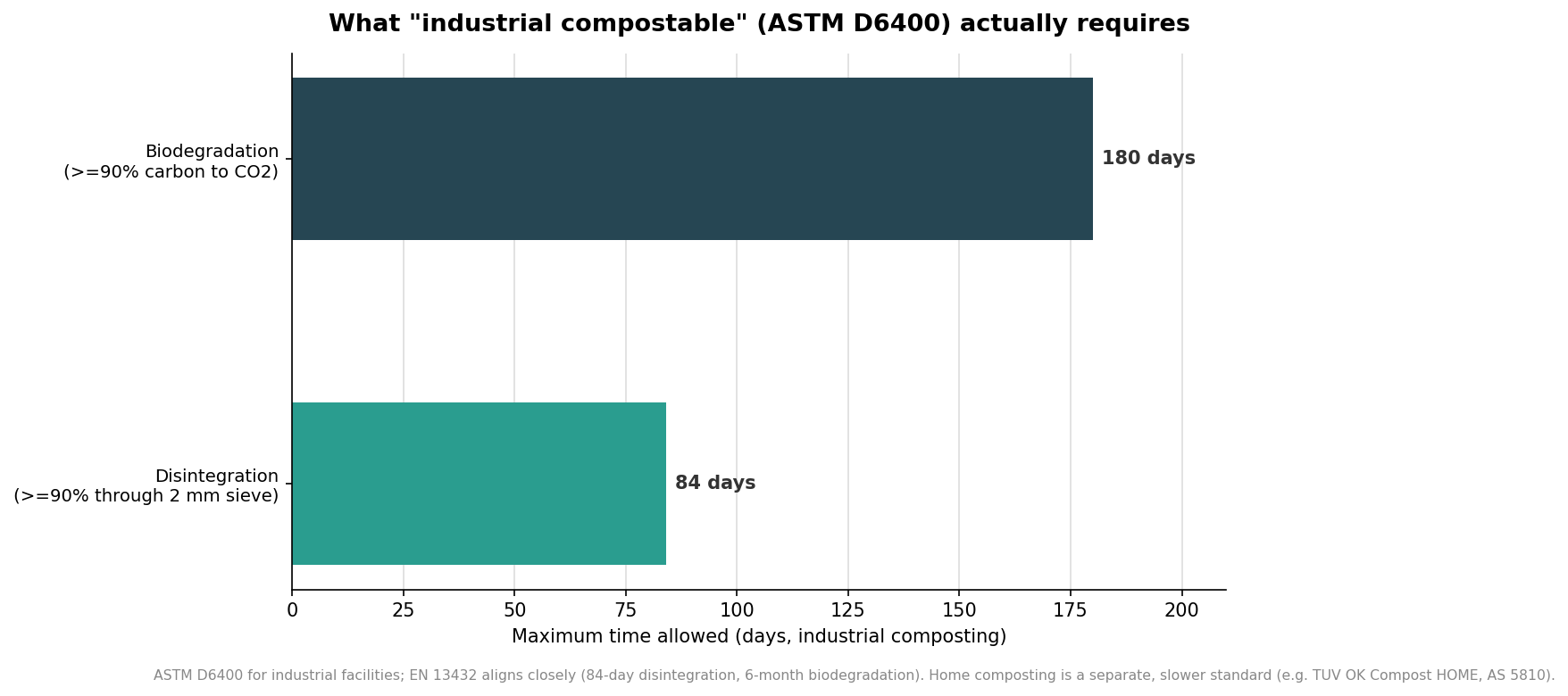
If you plan to put a leaf, a chasing-arrows symbol, or the word “compostable” on a pouch, understand that those claims are governed. A pouch marketed as industrial compostable in the U.S. is expected to meet ASTM D6400 for plastics, or ASTM D6868 for compostable coatings on fiber. That standard is specific: at an industrial composting facility the material must disintegrate so that at least 90 percent passes a 2 mm sieve within 84 days, and biodegrade to at least 90 percent conversion of its organic carbon to carbon dioxide within 180 days, with additional ecotoxicity and heavy-metal limits. Europe’s EN 13432 aligns closely. Crucially, these are industrial-composting standards; a pouch that meets them will not necessarily break down in a backyard bin, which is verified separately under home-compost schemes such as TUV OK Compost HOME or the Australian AS 5810.
The labeling itself carries legal exposure. The Federal Trade Commission’s Green Guides warn against unqualified “biodegradable” or “compostable” claims, and California has gone further: its truth-in-labeling law restricts the recyclability chasing-arrows symbol to materials actually collected and recycled, and a companion rule requires that anything labeled compostable meet the ASTM standards and be clearly identifiable. On the recycling side, most laminated barrier pouches that combine foil or multiple polymers are not accepted curbside; only mono-material polyethylene structures are designed for the film recycling and store drop-off pathways, and those programs themselves change, so verify current acceptance rather than printing a claim that may not hold. When in doubt, qualify the claim or leave it off.
Child-resistant and category-specific rules
Some contents pull in extra requirements. Cannabis and many nicotine or supplement products are sold in states that mandate child-resistant packaging, and the reference points are the federal test protocol at 16 CFR 1700.20, established under the Poison Prevention Packaging Act, and ASTM D3475, which classifies child-resistant packages. A child-resistant pouch has to pass testing with panels of children and adults, and a supplier selling into these categories should be able to point to a certified closure or a passing test report rather than simply calling a zipper “child-resistant.” If your product is a dietary supplement, remember the pouch is only one part of a labeling regime that also governs the panel content itself, so coordinate the packaging spec with whoever manages your label compliance.
Supplier quality systems and the paper trail
Beyond the product, the plant that makes your pouch matters to retailers and co-packers. The credentials they most often look for are a recognized packaging or food-safety management certification, commonly BRCGS for packaging materials, ISO 22000, or SQF. Ask whether the manufacturer holds one, and ask for a certificate of analysis or compliance for your run. Two more items round out the file. California’s Proposition 65 can require a warning if a product exposes consumers to listed substances, so confirm your packaging does not create an unexpected obligation. And the Toxics in Packaging laws adopted by roughly twenty states cap the sum of lead, cadmium, mercury, and hexavalent chromium intentionally added to packaging at 100 parts per million, which reputable film suppliers already meet but which you should still see stated.
None of this needs to be intimidating. The efficient path is to hand your supplier a short list and expect written answers: confirm food-contact compliance for the exact structure, confirm no intentionally-added PFAS, back any compostable or recyclable claim with the relevant ASTM standard or drop it, provide a certified child-resistant closure if your category requires one, and share the plant’s food-safety certification and a certificate of compliance. Get those five documents in hand before production and the pouch that lands on the shelf is not just attractive, it is defensible, which is exactly what a serious brand needs when a retailer or regulator comes asking.